
01 / Introductory
First principles
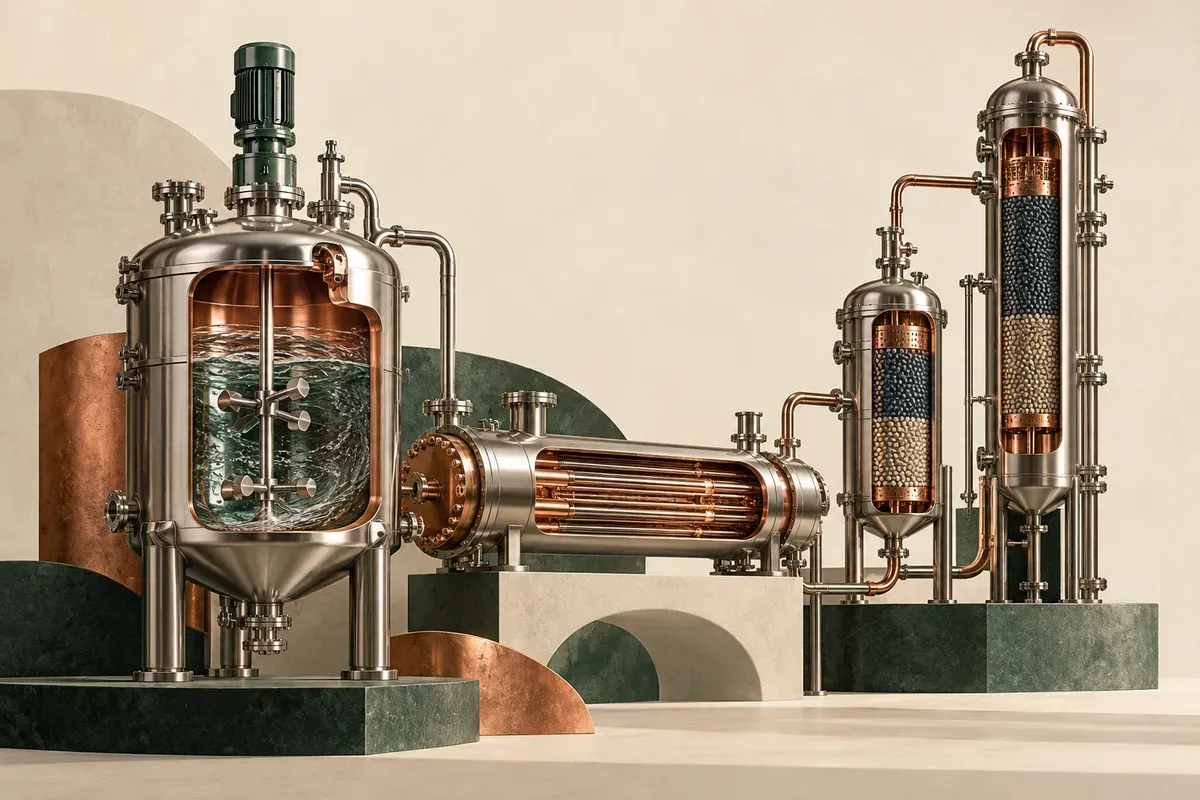
A reactor is a controlled place for chemical transformation.
A batch vessel is charged, reacted and discharged in separate steps.
It suits changing recipes and smaller campaigns, but charging, cleaning and unloading contribute to the total cycle time.
A continuous stirred tank reactor (CSTR) is idealized as perfectly mixed: its outlet composition equals the tank composition.
A plug flow reactor (PFR) has no axial mixing in the ideal model; each fluid element changes composition as it travels.
A fixed bed holds solid catalyst while fluid flows through it.
Fixed bed and PFR describe different things: catalyst arrangement and an ideal flow pattern.
Real packed beds can deviate from plug flow.
02 / Applied
Worked example
Consider an irreversible liquid reaction A → B, isothermal, first order, constant density, with k = 0.20 min⁻¹, inlet volumetric flow q = 2.0 m³/min and desired conversion X = 0.80.
For a CSTR, steady accumulation is zero and inlet minus outlet consumption equals reaction: FA0 X = (−rA) V.
Substituting CA = CA0(1−X) gives τ = 20 min and V = qτ = 40 m³.
Integrating the PFR balance gives τ = −ln(0.20)/0.20 = 8.047 min and V = 16.094 m³.
A constant-volume batch takes the same ideal reaction time, but not the same production cycle.
The comparison assumes identical temperature and kinetics and excludes downtime and heat-transfer limits.
−rA = k CA
CSTR: τ = X / [k(1 − X)]
PFR: τ = −ln(1 − X) / k
Batch: t = −ln(1 − X) / k
| Model | Time (min) | Volume (m³) |
|---|---|---|
| Batch | 8.047 | — |
| CSTR | 20 | 40 |
| PFR | 8.047 | 16.094 |
| Fixed bed | dFA/dW = r′A | — |
03 / Advanced
Engineering decisions
Choose by product selectivity and safety before minimizing volume.
For this positive-order example, mixing fresh feed with depleted liquid reduces the CSTR rate; autocatalytic or competing reactions can reverse a simple volume ranking.
Series CSTRs can approximate plug flow, while recycle modifies concentration and temperature profiles.
Exothermic duty requires an energy balance, cooling capacity, runaway assessment and relief design.
A fixed bed needs a mass-based rate, catalyst effectiveness, deactivation and a pressure-drop model; do not put a volumetric rate into dFA/dW = r′A.
Test residence-time distribution and kinetic data before treating an ideal model as plant performance.


Comments
There are no approved comments yet.
Without publication permission, your comment stays in your account.
Sign in by SMS to submit a comment.